
Montgomery Expected Versus Actual Release
A projected date is a planning field, not proof that a person left custody. ODRC labels its public field Expected Release Date/Parole Eligibility Date. Its definitions explain that the value can be a Projected Release Date or a date pending parole consideration. Those two meanings are not identical. One anticipates the end of a calculated term. The other marks when parole consideration may occur, and the Parole Board can deny release or continue the matter.
An actual release is an event. For a state prisoner, the current ODRC status and release details should show what happened, such as a judicial release, along with any APA supervision. For Montgomery County Jail, the MCSO book-out record supplies the date, time, disposition, and receiving agency when custody continues elsewhere. A court order gives the legal authority but does not prove physical departure until corrections processes it.
Scheduled versus actual: Label the ODRC field as expected or eligibility-based until the current status and release event confirm that custody ended.
| Date or event | Meaning | Confirmation source |
|---|---|---|
| Expected Release Date | ODRC’s current projected calculation | ODRC person detail and current status |
| Parole Eligibility Date | Date when an eligible case may be considered | ODRC hearing field, person result, and official decision |
| County sentence completion | Local calculation using sentence and credited time | Sentencing entry and MCSO computation |
| Actual release or transfer | Physical end of that custodian’s episode | Release record, receiving agency, and updated status |
Find Montgomery County Release Dates
Start with the facility, sentence, and a strong identifier. JusticeWeb covers current Montgomery County Jail custody. ODRC covers Ohio prison, judicial-release, and APA records. Federal BOP and ICE systems answer different custody questions and should not be substituted for either local source. A person transferred from the jail to Dayton Correctional Institution remains incarcerated even though the county booking has ended.
- Determine whether the person is pretrial, serving a county-jail sentence, or serving an ODRC sentence. Use the latest court docket and current custodian.
- For state custody, open the ODRC Offender Search. Search by exact name, then use the ODRC number to resolve duplicate names.
- Read status, institution, committing county, docket, jail-time credit, sentence fields, and the exact Expected Release Date/Parole Eligibility Date label.
- For a county sentence, obtain the sentencing entry and ask MCSO for its computation or release record. Do not calculate the local date from sentence length alone.
- Check for other cases, consecutive terms, mandatory time, warrants, or agency holds before treating any displayed date as likely.
- After the anticipated day, confirm the actual event through the updated custodian record. A transfer must be reported as a transfer, not a release home.
The ODRC definitions page states how its public date and status terms should be read.
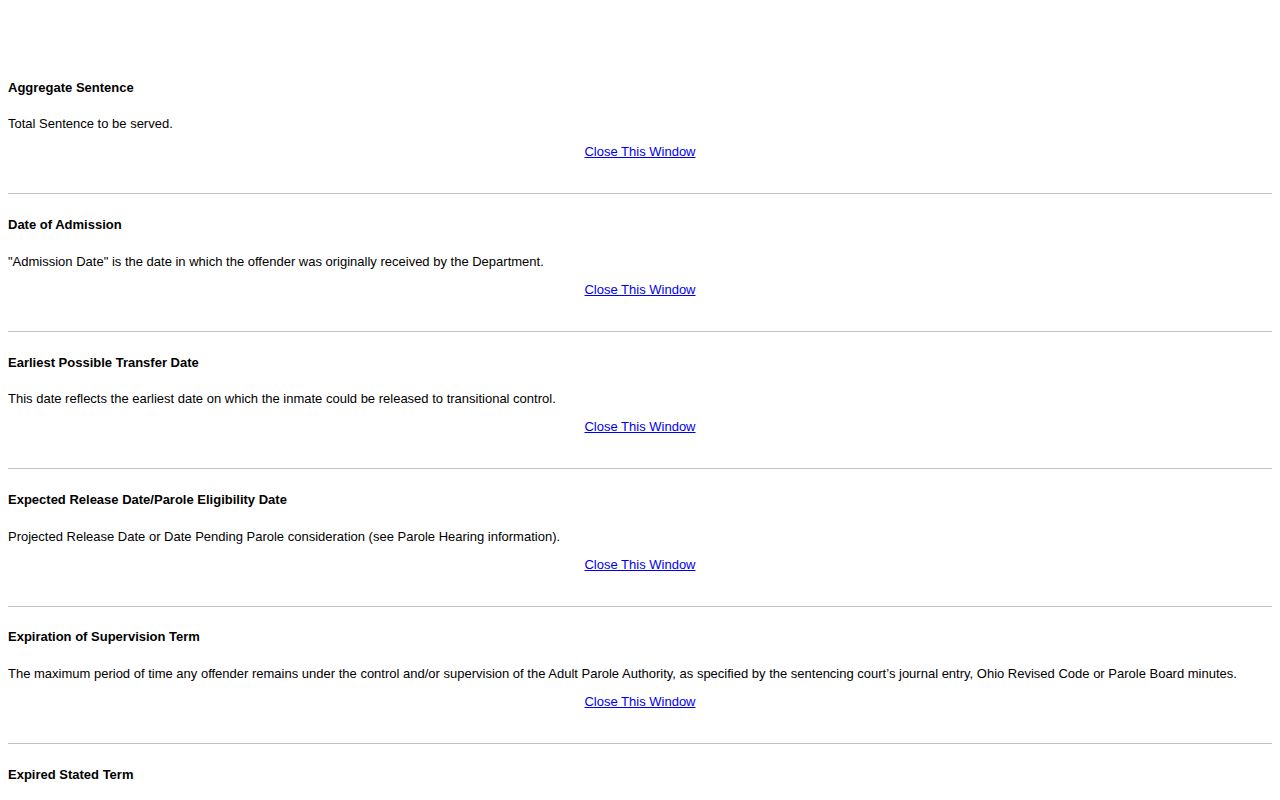
The definitions prevent a common error: turning a projected or eligibility date into a claim that release already occurred.
Note: County of commitment is the sentencing county, not necessarily the present institution, residence, or place where release will occur.
Montgomery County Jail Date Calculation
A pretrial detainee generally lacks a set sentence-completion date. A bond order may authorize release, but payment, conditions, paperwork, identity checks, and other holds can still delay book-out. JusticeWeb’s absence of a name proves only that the current roster no longer reports the person at that snapshot. It does not distinguish bond release, dismissal, transfer, or another custody change.
For a sentenced local inmate, read the sentencing entry in the correct court. Record the imposed term and any jail-time credit. Then ask MCSO how that term was computed for the specific booking. The county release record should be requested when the actual departure matters. A useful request seeks the booking number, book-out date and time, exact disposition, and destination or receiving agency. MCSO Records is at 345 W. Second Street, Dayton, with a weekday public counter from 8 a.m. to 3 p.m.
Montgomery cases may be spread across several court portals. PRO covers Common Pleas General and Montgomery County Municipal matters, among others, while Dayton, Kettering, and Miamisburg use their own public systems. Follow the charging court and case number. A dismissal in one case may coexist with a hold in another, and a sentence entry may be followed by a violation or modified order.
The full Montgomery County released-inmate record path explains how to reconcile the current roster, MCSO book-out record, and court docket when the date has passed.
Ohio Earned Credit Release Rules
ORC 2967.194 governs current earned credit for confinement beginning April 4, 2024. Eligible prisoners provisionally earn one or five days per completed month for qualifying productive participation. The specified class of pre-September 30, 2011 sexually oriented offenses receives one day, while most eligible classifications receive five. ODRC can deny or withdraw provisional credit for rule violations and finalizes it after administrative review.
The ordinary aggregate participation and completion credit under the cited mechanism is capped at fifteen percent of the stated term. Yet the statute also has a separate completion provision that operates notwithstanding that cap. It grants ninety days or ten percent of the stated term, whichever is less, for each listed diploma, program, or criterion, subject to exclusions. Mandatory or nonreducible terms and certain serious sentence categories are excluded.
The current statute’s detailed structure appears in the official Ohio code source.
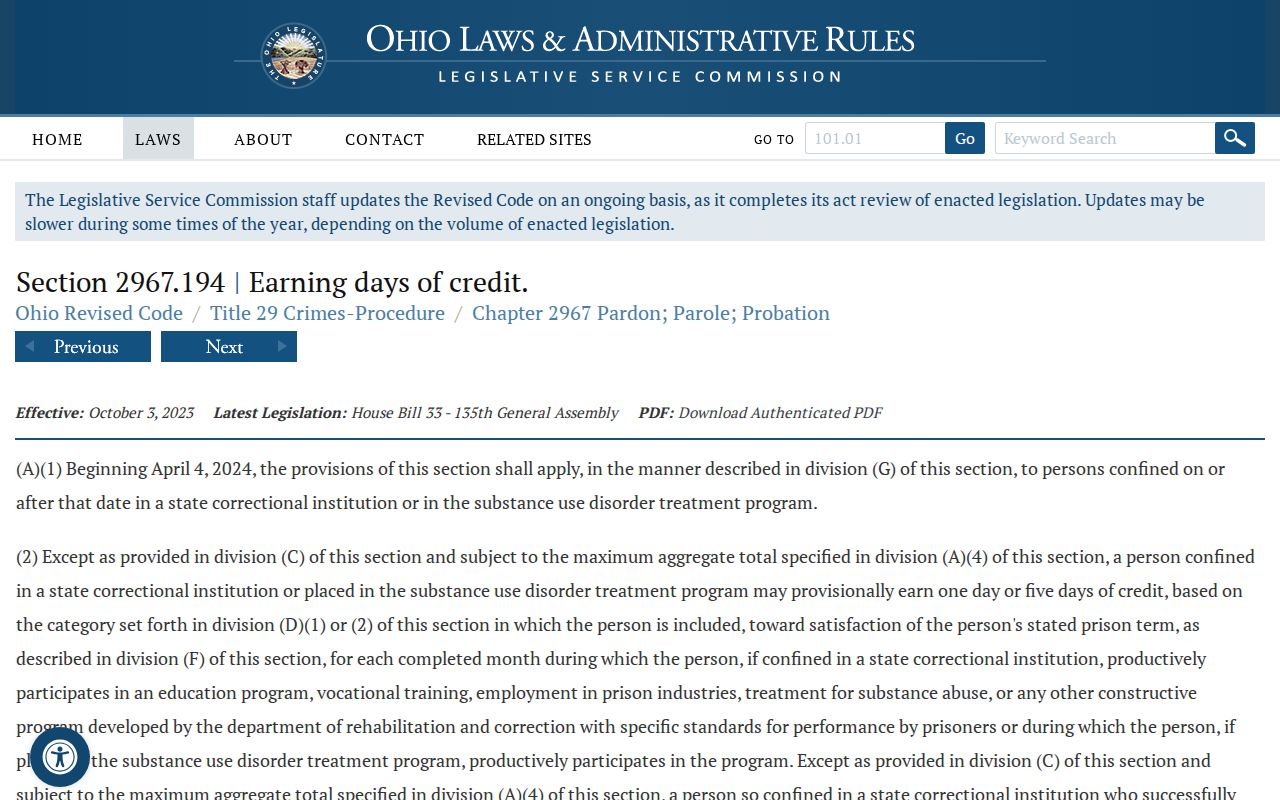
The person-specific ODRC field remains the practical public lookup because eligibility, exclusions, conduct review, and program completion cannot be reduced to one percentage.
No universal 85-percent rule: Ohio release calculations depend on sentence date, offense, mandatory portions, credited time, earned-credit eligibility, and later official action.
Older Montgomery County Sentence Credits
Older periods of confinement can fall under former ORC 2967.193 and its transitional rules. The former framework includes eight-percent and fifteen-percent provisions tied to the applicable dates and classifications. It should not be mixed with the present monthly participation system. The sentence date and confinement period determine which law needs review.
The former statute is preserved in this official source capture.
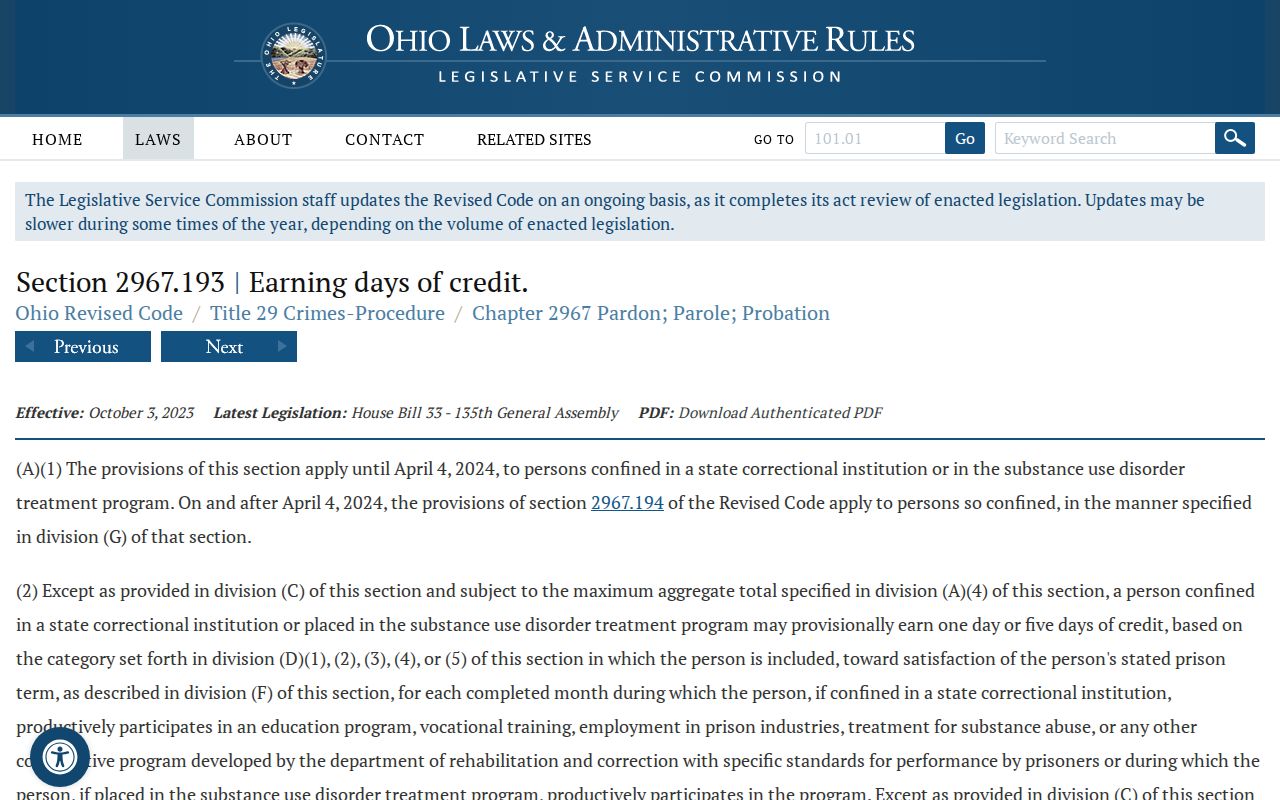
Because the transition can be complex, the court judgment and ODRC calculation should control over a date produced from a general online formula.
Truth-in-sentencing also does not create one shortcut. Post-July 1, 1996 definite or stated terms differ from old-law discretionary parole sentences. Mandatory portions, jail-time credit, earned-credit rules, program awards, and judicial action still affect the public date. A life-without-parole sentence never becomes parole eligible, while other life and old-law terms may use person-specific eligibility rules under ORC 2967.13.
Note: A parole eligibility date opens consideration; it does not promise a favorable decision or physical release on that date.
Why Montgomery Release Dates Change
An expected date is recalculated when the facts controlling the term change. Some changes are administrative, such as final earned-credit review. Others come from a judge, another case, or a Parole Board decision. The public field should therefore be captured with the date of the search and checked again near the expected event.
| Factor | Possible effect | Record to check |
|---|---|---|
| Jail-time credit | Credits qualifying prior confinement against the sentence | Sentencing entry and ODRC sentence panel |
| Earned credit or conduct | Adds, denies, withdraws, or finalizes eligible time credit | ODRC calculation and ORC 2967.194 |
| Mandatory time | Blocks reduction during a required part of the term | Judgment entry and offense statute |
| Consecutive cases | Extends the aggregate term when terms run in sequence | All controlling dockets and ODRC detail |
| Judicial action | May grant judicial release, modify an order, or change custody authority | Signed court order and updated corrections status |
| Detainer or hold | Can cause transfer to another custodian instead of community release | Custodian record and receiving-agency entry |
| Parole review | Can approve, deny, or continue an eligible case | ODRC person result and official minutes |
ODRC warns that public sentencing information may be incomplete. That is why consecutive and concurrent terms, jail credit, mandatory time, or multiple cases should be reconciled with the sentencing court and, when needed, Central Records. Do not expand a local code or calculate from sentence length alone.
A change should be logged with its source and lookup date. That preserves the difference between an older projection, a later recalculation, and the final release event.
Montgomery Parole Date Review
The ODRC search includes a “Next Parole Board Hearing Date” field in YYYYMM format. A monthly search can locate people scheduled in that month. ODRC’s definitions state that a future case is reviewed about two months before the displayed date, so the hearing or decision may occur earlier. There is no verified stand-alone day-by-day Ohio parole calendar in the research.
Open the person result and read both “Next Parole Board Hearing/Review Month” and “Latest Parole Board Hearing/Review Type & Results” when present. A recommendation, approval, denial, or continued date is not the same as actual release. New information or review can still affect the outcome before physical departure. Official decision minutes may be requested under ORC 5149.11 using the person’s name, ODRC number, and review month.
This channel-sweep step is especially important when the same public field combines projected release and parole eligibility. The sentence category determines whether term calculation or discretionary review controls. The detail page, decision record, and current status must be read together.
Confirm Montgomery County Release
After the expected day, check the same custodian again. An ODRC result marked “RELEASED - Judicial Release” is affirmative state-system evidence of a prison release mechanism, but an APA panel may still show supervision. A Montgomery County Jail record should distinguish release into the community from transfer to ODRC, another jail, USMS, or ICE. The end of one custody episode is not always the end of confinement.
VINE can send a source-fed custody-change notice, but it is not a certified book-out record and has no promised permanent retention window for recently released results. Register before the expected event when possible, verify the reporting agency, and preserve the exact status and alert time. Then confirm the event with MCSO for county custody or ODRC for prison custody. The Montgomery County VINE inmate check covers registration and PIN acknowledgment.
For state records questions, write Ohio Department of Rehabilitation and Correction, Attn: Central Records, P.O. Box 430, Columbus, OH 43216. Request permitted release or discharge-status confirmation with the exact name and ODRC number. Most of the institutional file is not public under ORC 5120.21, so a narrow request is more useful than a demand for the full file.