
Montgomery County Supervision Types
Parole, post-release control, probation, and community control all restrict a person after custody, but they do not come from one office. The Ohio Adult Parole Authority, or APA, is part of the Ohio Department of Rehabilitation and Correction. It follows qualifying state-prison releases, including parole and post-release control. Montgomery County Common Pleas Probation Services is a local court department. It supervises felony and misdemeanor cases in intensive, basic, courtesy, and monitored-time categories.
The key question is not whether someone casually calls the status “probation.” It is which order and which agency govern the person. The sentencing docket can identify community control and the local probation department. An ODRC detail can identify APA supervision, its start, its period, and the assigned APA office. A person may also have duties in more than one record system, so each case and custody episode must be checked on its own.
| Supervision | Source | Best verification |
|---|---|---|
| Parole | Release after a parole decision in an eligible state case | ODRC status, parole result, APA details, and sentencing docket |
| Post-release control | State supervision following a qualifying prison term | ODRC APA Supervision record and court sentence |
| Probation or community control | Montgomery County sentencing court | Correct court docket and Common Pleas Probation Services |
| Day reporting | Structured MCSO jail alternative under court obligations | MCSO program information and sentencing docket |
- Parole
- Conditional release after parole eligibility and an official decision.
- Post-release control
- APA supervision imposed after release from a qualifying Ohio prison sentence.
- Community control
- A court-ordered local sanction often described as probation.
- Discharge
- The official end of the supervision term, not merely release from a jail or prison bed.
Verify Montgomery County Supervision
Begin with identity and the most recent custody setting. A county-jail book-out does not show whether APA or local probation follows. A state-prison result does not establish that the person reports in Montgomery County, either. Use the exact name, date of birth, case number, booking number, or ODRC number when available, then reconcile the agency field with the sentencing court.
- Search the ODRC Offender Search by exact name or ODRC number. Try “APA Supervision” and “Released” separately, or “All” when the current category is uncertain.
- Open the correct detail and read the status exactly. Record the supervision start, supervision period, APA office, committing county, docket, and any hearing or review result.
- Search the controlling court. Public Records Online covers Montgomery County Municipal, Common Pleas General, Domestic Relations, and the Second District, but independent municipal courts use separate portals.
- For court community control, contact Montgomery County Common Pleas Probation Services. For APA supervision, use the office named in the ODRC detail.
- Confirm a claimed end date or discharge through the updated agency record and final court entry. Do not treat release from physical custody as the end of supervision.
The ODRC search form itself is useful because its filters show the legal distinctions. The official Ohio offender search is shown below.
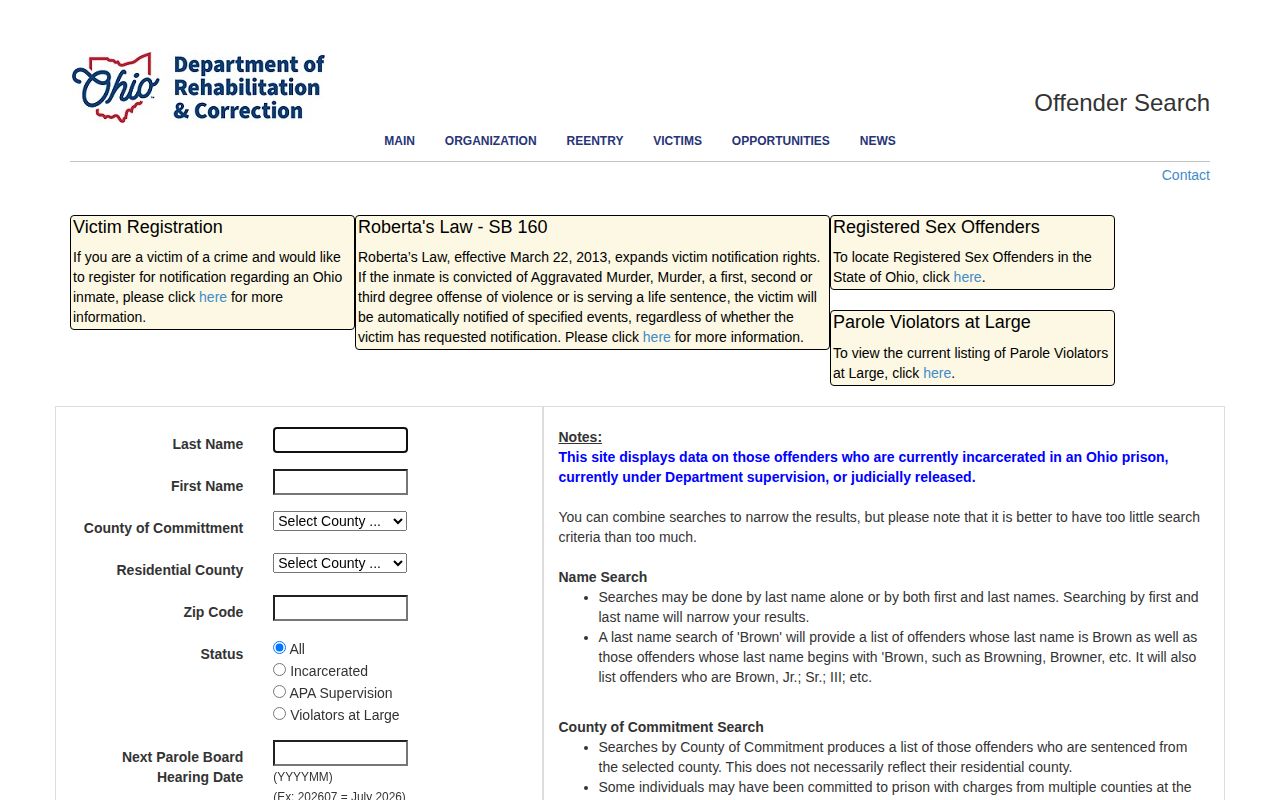
Use the status choice to narrow the result, then verify the person by number and docket rather than by name alone.
Important: County of commitment identifies the sentencing county. It is not a current home address or a guarantee that Montgomery County is the reporting location.
ODRC Montgomery Release Filters
ODRC offers first and last name, ODRC number, county of commitment, residential county or ZIP, status, and a next Parole Board hearing month in YYYYMM form. County filters require care. When a person has cases from more than one county, ODRC warns that only the first committing county may be searched or reported. The residential county and ZIP fields apply to APA or Violators at Large records and reflect the last recorded address, which may be stale.
A Montgomery committing-county result proves a sentence connection, not current residence. On the person detail, separate identity, prison status, supervision, and date fields. An expected release date is not the same as an APA start. A judicial-release status may coexist with an APA panel showing continued control. The public ODRC search covers current prisoners, current department supervision, and judicially released people, but it is not a complete archive of every past discharge.
| Search choice | Use Released for ODRC-reported releases; use APA Supervision for parole and post-release control. |
|---|---|
| Identity check | Match the ODRC number, name, date of birth, committing docket, and photo when shown. |
| Office check | Read the named APA office instead of inferring an office from the county filter. |
| Date check | Keep expected release, supervision start, review month, and discharge as separate events. |
Note: ODRC sentencing data may be incomplete, so the court entry remains essential when several cases or terms affect supervision.
Montgomery County Probation Office
Local probation is not automatically found in an APA search. Montgomery County Common Pleas Probation Services handles court supervision for local felony and misdemeanor cases. The docket should show the community-control order, later violations, modifications, and termination when public. If the case began in a different municipal court, follow that court’s case number and clerk route rather than assuming PRO contains every controlling order.
The official Common Pleas Probation Services page describes the department and its supervision categories. The captured page below helps identify the correct local office, not a state APA office.
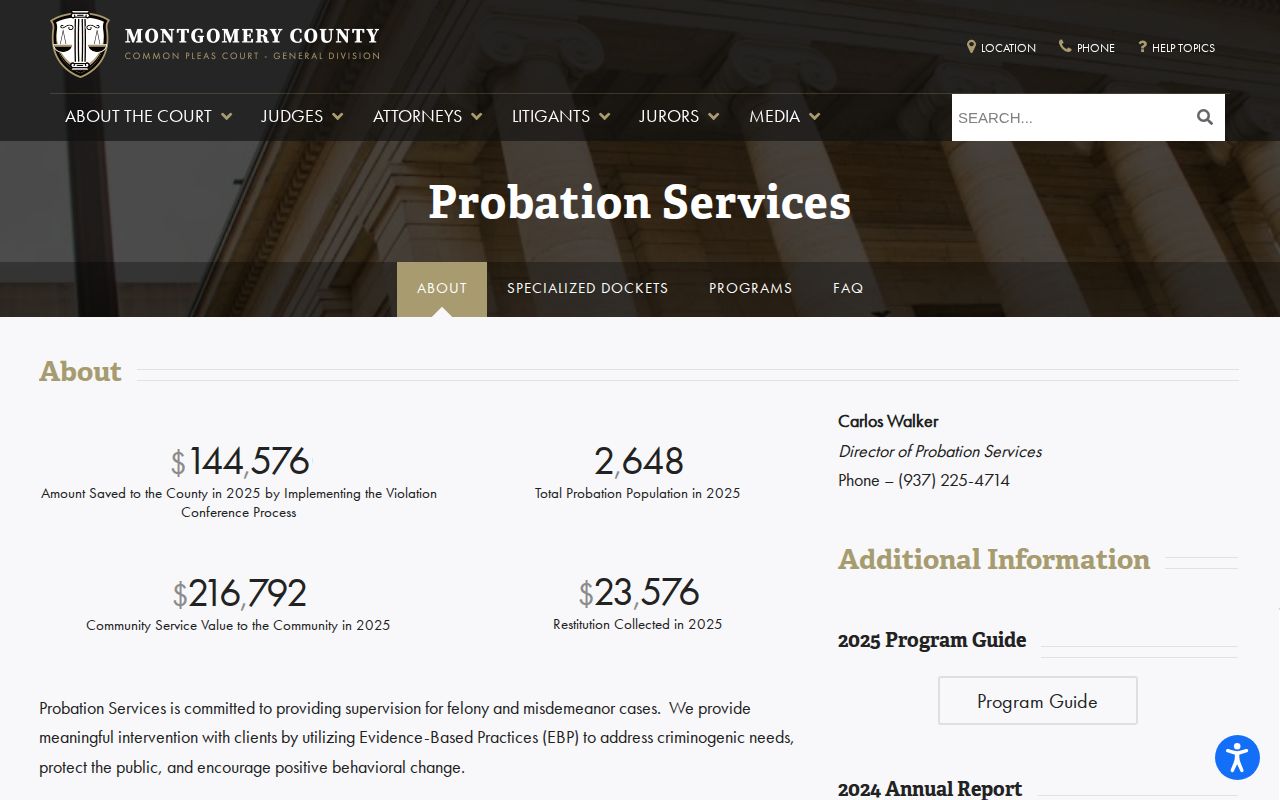
A call to the probation department should be tied to the correct public case and should not seek protected case-management details.
Common Pleas Probation Services
41 N. Perry Street
Dayton, OH
937-225-4714
General court hours: Monday through Friday, 8:30 a.m. to 4:30 p.m.
ODRC Central Records
Attn: Central Records
P.O. Box 430
Columbus, OH 43216
Request permitted release or discharge-status confirmation with the person’s name and ODRC number.
Montgomery County Reentry After Release
Montgomery County operates a local navigation point for people returning from both county and state incarceration. The Office of Reentry accepts weekday walk-ins at 1133 S. Edwin C. Moses Boulevard, Suite 370, Dayton, and can be reached at 937-496-7129. Its separate training center is at 1111 S. Edwin C. Moses Boulevard, Suite 1175, with Tuesday through Thursday appointments through 937-496-6604.
This reentry layer does not prove parole, probation, or discharge. It is practical navigation after custody. The county’s Reentry Collaborative spans returns from local and state incarceration and moved to quarterly stakeholder forums in April 2025. A person may use reentry services without an APA record, and someone on APA or court supervision should still follow the supervising agency’s directions.
Note: Reentry service participation is not a custody-status record and should never replace the ODRC detail or court docket.
Property After Montgomery County Release
Transfer changes the property route in Montgomery County. Direct bulk-property retrieval uses an MCSO form, an appointment, and valid photo identification at Property Management on the lower level of 345 W. Second Street. The office number is 937-225-4145 and the published hours are 8 a.m. to 4 p.m. No public on-site parking is offered.
A person transferred to another institution and only later released follows a different route. MCSO directs that person to the jail Property Room at 330 W. Second Street, Monday through Friday from 8 a.m. to 2 p.m., with holidays closed unless advance arrangements were made. The distinction matters because a county book-out may have been a transfer, while the person’s later community release occurred through ODRC or another custodian.
The MCSO property and evidence instructions should be checked before travel because the appointment and identification rules control. Property pickup is a personal logistics step. It is not a public supervision lookup and does not show whether parole or probation remains active.
Montgomery County Warrants and Absconders
ODRC’s Violators at Large, or VAL, listing is an official lead for an alleged APA violation or absconder status. “Absconder” generally means the agency reports that a supervised person has stopped complying with required contact or location duties. The public listing can show a photo, name, number, date of birth, declared-VAL date, and offenses. It is not independent real-time warrant certification.
The ODRC VAL page instructs users not to apprehend anyone and says law enforcement must confirm the warrant through LEADS or NCIC. The official lookup is captured here.
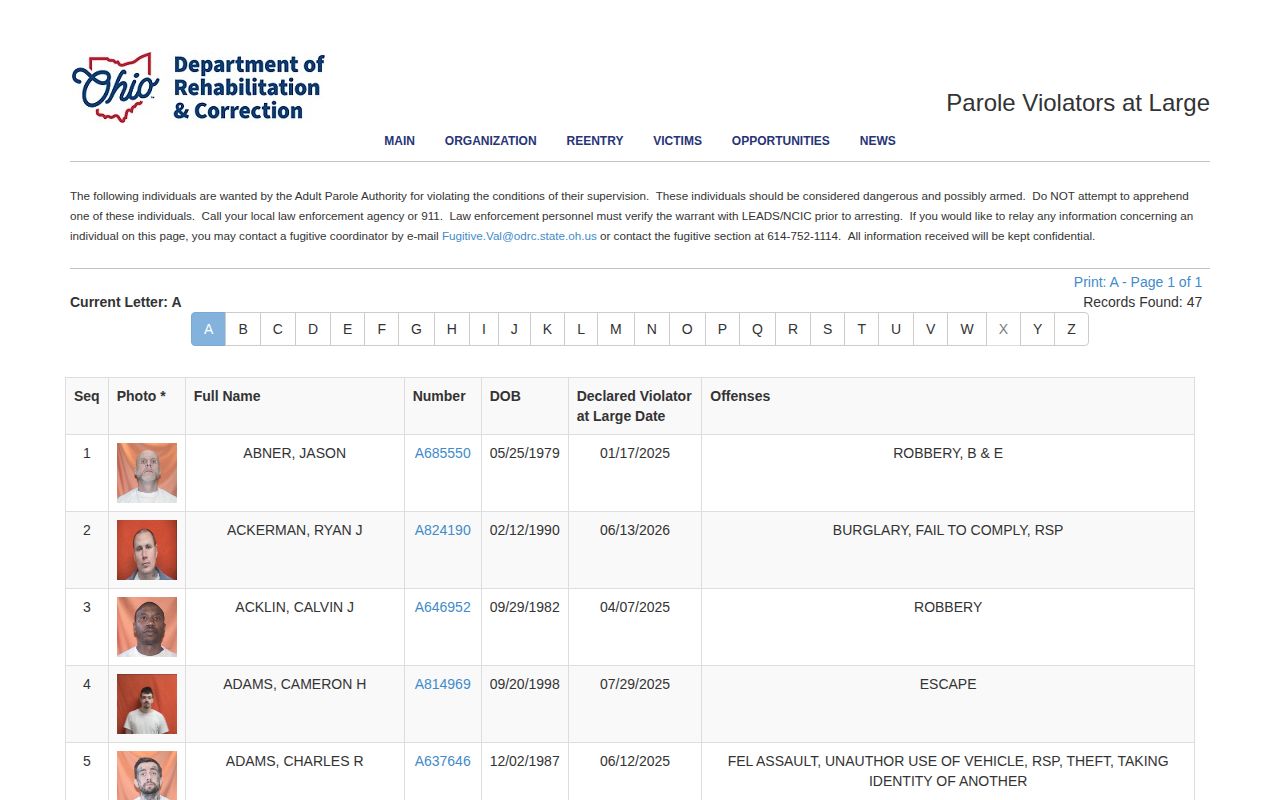
The warning defines the proper use of the public entry: note it, avoid confrontation, and let law enforcement confirm it.
Local warrants use separate routes. Common Pleas provides one help page for checking a current warrant and another for identifying the offense tied to probation. A warrant does not prove a fresh jail booking. Cross-check JusticeWeb for current county custody and read the court docket for the case sequence.
Safety: Never approach or try to detain a person based on a public VAL or warrant page. Confirmation belongs to law enforcement.
Ending Montgomery County Supervision
Release from jail or prison and discharge from supervision are different events. APA supervision ends when ODRC records the applicable termination or discharge, subject to the person’s sentence and official action. Local community control ends through the sentencing court and probation record. An expected end date, an old address, or silence in a public search should not be converted into a final discharge without the updated record.
Ohio public-record limits also shape what can be confirmed. ORC 149.43 excludes many probation, parole, community-control, and post-release-control proceeding records. ORC 5120.21 limits most ODRC file material while allowing specified identity, conviction, photograph, supervision, incarceration-place, and discipline information. A narrow request for permitted discharge-status confirmation is more accurate than asking for an entire file.
When physical release itself is still uncertain, the complete Montgomery custody chain starts with the released-inmate search and release-record process. Match the jail book-out or ODRC release status to the court order, then keep supervision and final discharge as later, distinct events.